
Mason County Parole and Probation Compared
Probation is a sentence imposed through the circuit court, often instead of incarceration or as part of a case disposition. Mason County Probation describes several local forms, including Informal Supervision, Reporting Court Supervision, Standard Probation Supervision, and Drug Court Probation. The department manages the person’s reporting and operational requirements, but its case files are not a public people-search service.
Parole and mandatory supervised release, often shortened to MSR, follow state incarceration. IDOC remains the correctional authority. The Illinois Prisoner Review Board sets or adjudicates relevant conditions in matters within its jurisdiction. A state profile may show an Offender Status of “PAROLE” and a Location identified as a parole district. That is different from a Mason probation order and different again from final discharge.
| Record type | Who controls it | Public verification |
|---|---|---|
| Probation or court supervision | Mason court and local Probation Department | Circuit Clerk docket, sentencing order, and later court entries |
| Parole or MSR | IDOC and applicable PRB process | IDOC offender profile, parole district, and state confirmation |
| Final discharge | State correctional authority or court, depending on sentence | Later IDOC/PRB action or court termination order |
Check Mason County Supervision Records
Begin with the case type rather than a broad name search. A local jail release may lead to probation, no supervision, transfer, or another outcome. A state-prison release may lead to parole or MSR. The same person can have records in more than one system, but each record proves only the event its agency controls.
- Identify the sentence. Use the Mason County Circuit Clerk page and its official Judici route. Look for the disposition, probation order, mittimus to IDOC, later petitions, and termination or resentencing entries.
- For local probation, stay with the public docket. Mason Probation cannot divulge its departmental case file under 730 ILCS 110/12(4). The Clerk can address public case information.
- For parole or MSR, search IDOC. Use the IDOC Individual in Custody Search by name or IDOC number. Read Offender Status, Location, actual Parole Date, Projected Parole Date, and Projected Discharge Date as separate fields.
- Confirm the supervising level. A “PAROLE” status and numbered parole-district location support state supervision. Call IDOC at 800-666-6744 when the agent or district assignment needs confirmation.
- Read later action. Check the public court docket for probation completion or revocation. For applicable state matters, check PRB calendars, results, or written confirmation rather than assuming supervision ended with time.
Illinois VINE can provide custody or criminal-case notifications through county booking systems, IDOC, DHS, and circuit clerks. It is useful as an alert source, not a certified supervision record. Verify a VINE event with the contributing agency, especially when “release” might mean transfer from one custody source.
Mason County Probation Office Records
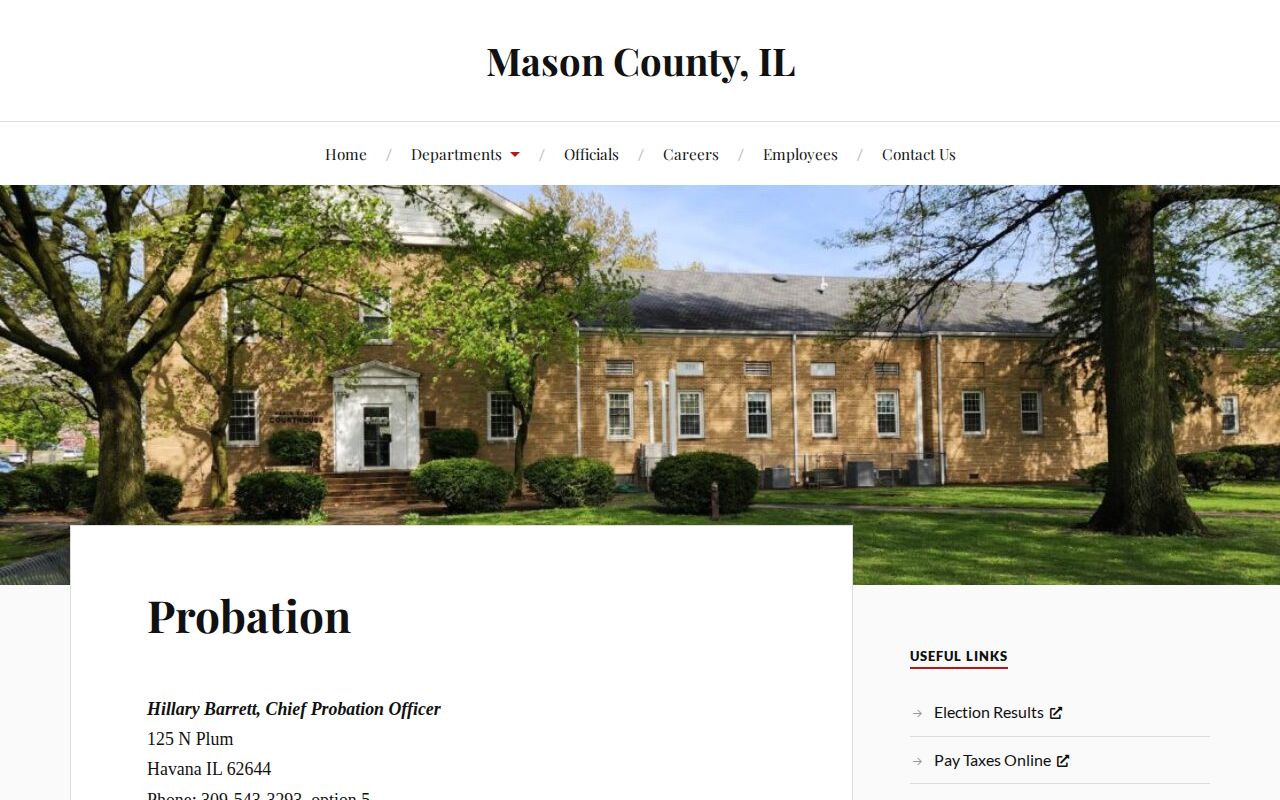
The Mason County Probation Department is at 125 N. Plum Street, Havana, Illinois. Its telephone number is 309-543-3293 option 5, and its fax is 309-543-4403. Published hours are Monday through Friday, 8 a.m. to noon and 1 p.m. to 4 p.m. Those split hours matter to people reporting or rescheduling, but they do not turn the office into a public probation lookup.
125 N. Plum Street
Havana, IL 62644
309-543-3293, option 5
Monday-Friday: 8 a.m.-noon and 1-4 p.m.
The county directs a person who missed a probation appointment to call the probation officer immediately to reschedule. A missed court appearance belongs with the Circuit Clerk. Address changes and new arrests or tickets should be reported to the officer. These are supervisee obligations, not methods for a member of the public to obtain confidential case notes.
The official Mason probation page shows the local office and its published access boundary.
Use that office for an existing supervisee’s operational contact; use the Clerk’s public record to research the case status.
Mason County Probation Files and Hours
Mason’s most distinctive supervision rule is easy to miss: the office publishes practical reporting hours while drawing a hard confidentiality line around probation files. Section 12(4) of the Illinois Probation and Probation Officers Act makes those records nonpublic except to specified judges and probation officers or by court order. Calling during office hours does not create public access to a person’s file.
This boundary changes the correct search strategy. Read the public sentencing order, then look for later docket entries such as a petition alleging violation, a hearing, an order terminating probation, or resentencing after revocation. A public docket may not expose every operational detail, but it is the lawful public route. Do not try to obtain protected notes indirectly from staff, family members, or unofficial databases.
Mason County Supervision Violations and Warrants
Conditions vary with the legal status and order. For local probation, noncompliance can be reported to the State’s Attorney, who may seek revocation. The court decides the issue after the required process and can revoke probation and resentence the defendant. An old docket entry showing probation therefore does not establish current compliance or completion. Later entries control.
For parole or MSR, conditions are governed by 730 ILCS 5/3-3-7 and state correctional procedures. A revocation proceeding may return someone to supervision with or without added conditions, resume supervision after a no-violation finding and plan approval, or revoke supervision so IDOC can calculate the resulting custody and release status. PRB appeal action may reopen, reset, deny, or reverse a prior revocation decision.
IDOC’s Wanted Fugitives page is only a supplemental channel for selected wanted people. It is not a complete Mason County warrant list, and absence from it does not prove compliance. Direct a court warrant question to the applicable court or sheriff. Direct a parole warrant or agent question through IDOC and the relevant PRB process. Mason County did not publish a complete local absconder list in the reviewed official sources.
PRB Hearings and Results
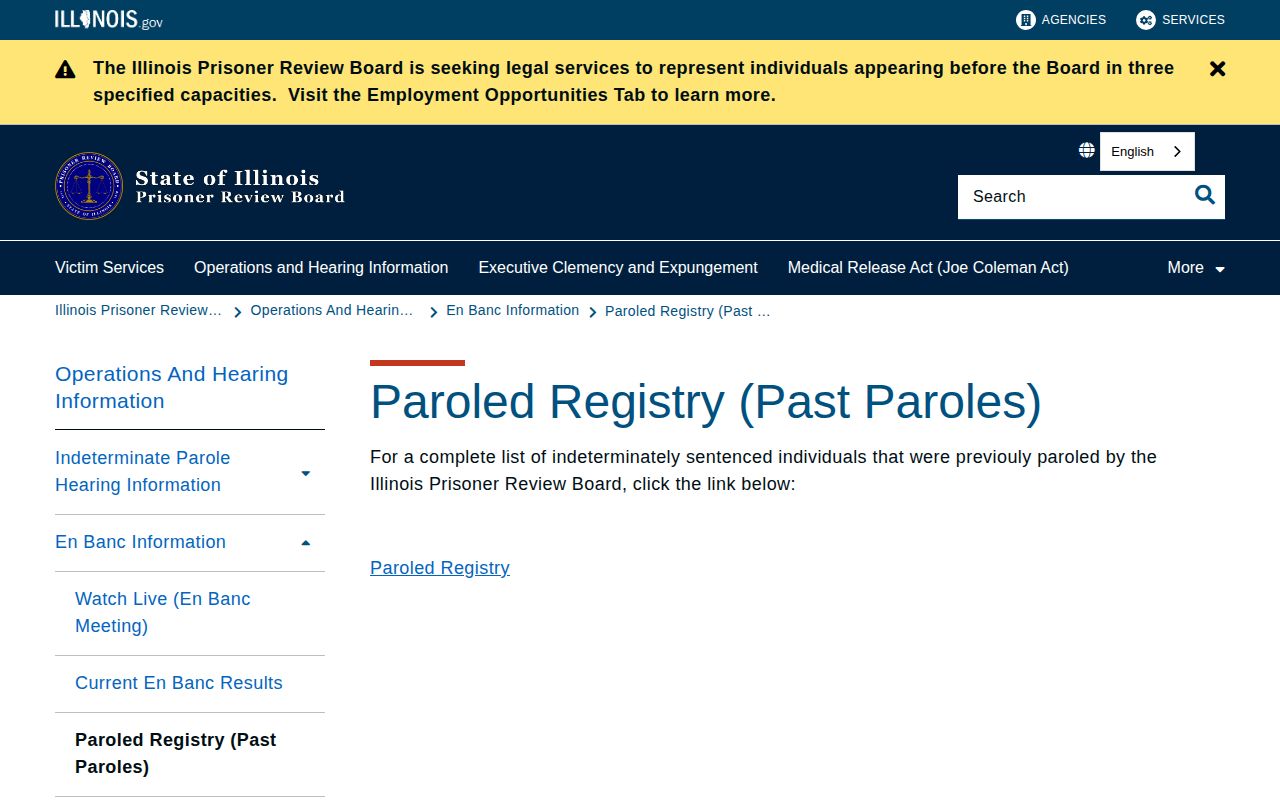
The Illinois Prisoner Review Board publishes operations information, monthly calendars, yearly en banc dates, revocation schedules and results, current en banc results, and a past-paroles registry. These materials should be used for proceedings actually within PRB jurisdiction, then paired with the current IDOC profile. They are not a universal flexible name search.
The PRB past-paroles registry provides a separate official research view.
A hearing grant is not proof of same-day physical release. Release planning, conditions, calculations, or later action may occur between the vote and movement out of custody.
Traditional parole eligibility mainly concerns old-law indeterminate sentences for offenses before 1978. Modern determinate sentences generally lead to MSR rather than traditional parole. Illinois also has a separate youthful-parole framework under 730 ILCS 5/5-4.5-115 for qualifying cases. Because eligibility depends on offense, age, sentence date, and current statutory text, the actual law and case record should be read instead of applying a simple age or years-served formula.
Confirm Mason County Supervision Discharge
Completion requires an event from the authority that controls the sentence. For probation, seek the public court order terminating the sentence or showing another final outcome. For parole or MSR, read the IDOC profile and applicable PRB record. The PRB may approve early final discharge when statutory findings are met, including consideration of a Parole Division risk-and-needs assessment. Until final discharge, a person released on parole or MSR remains in IDOC legal custody and may be retaken under lawful process.
Keep projected and actual dates separate. A Projected Discharge Date anticipates the end of correctional legal custody. An actual Parole Date records movement from incarceration to supervision. Neither should be rewritten as proof of final discharge without the later official record. The broader Mason County released-inmate records guide explains how to reconcile the court, jail, and state custody entries.
When records appear inconsistent, compare the agency and event before assuming an error. A Mason court may enter a probation sentence while the Probation Department properly refuses to disclose its operational file. IDOC may show parole after a Mason jail record documents transfer to state custody. VINE may alert when it receives an update rather than at the exact time of release. Preserve the field label and access date, then ask the office responsible for that event to correct a genuine discrepancy.
A person’s absence from a wanted-fugitives page, an old calendar, or a current jail roster does not prove successful completion. Strong confirmation comes from the public termination order for probation or the applicable state discharge record for parole or MSR. That approach respects Mason’s confidentiality rule while still using the public records that lawfully document the outcome.